Hiking/Backpacking "X" Factor
The theme that runs through all of my pod casts is light weight hiking. Several of my friends have tried hiking/backpacking with little success. I will tell you more about how one of these hikes turned out later. I developed a way I evaluate a friends ability to successfully complete a hike before we ever consider hiking. This means of evaluation was developed solely on the observation of hikers by me during my 20+ years of trail hiking. The process is not based on any medical research and I used it only as an estimate of ones possible ability to complete one of my hikes. I excluded friends with medical conditions (example: high blood pressure, heart condition, etc,). I made sure that they had had a physical exam by a doctor and was determined in good enough condition to hike safely. The "X" Factor is a number that indicates how much more effort a hiker "friend" may have to expend to hike the same distance as an average hiker. I have taken into consideration the weight of the pack, the weight of the person, age and physical condition. A person who is 40 years of age, in good physical condition, at their optimum body weight carrying a 30 pounds pack should be able to complete a 10 to 25 mile hike in one day without much effort. No effort was given to distance or speed of the hiker in this evaluation.
Score Points
The object of the evaluation is to add all "X" Factor points together while trying to get as close to zero as you possibly can. A hiker friend who scores a total of zero should be able to complete one of my distance hikes.
Age
10 20 30 40 50 60 70 80 Years
-3 -2 -1 0 +1 +2 +3 +4 Points
Physical Condition
Excellent Good Fair Poor Condition
-1 0 +1 +2 Points
Pack Weight in Pounds
10 20 30 40 50 Pounds
-2 -1 0 +1 +2 Points
Hikers Weight in Pounds Over/under Optimum Weight
-10 -5 0 +5 +10 +20 Pounds
-2 -1 0 +1 +2 +3 Points
A hiker who is 30 years old in good condition carrying a 40 pound pack and is 10 pounds over weight would have an "X" Factor of +2. This means this hiker would have to exert twice the effort to complete a 25 mile hike in one day.
My Experience Before I Developed the "X" Factor evaluation
I have a friend I asked to go on a hike with me. He assured me that he was in good enough condition to hike and that he had just retired from the military and was used to taking 10 mile hikes with a full pack. I planned a 3 day 2 night 30 mile hike. He was 55 years old in fair physical condition about 10 pounds over weight and carried a 50 pound pack. We hiked 9 miles the first day and he was too tired to finish the second days hike. The hike was too strenuous for him to complete.
If I had evaluated him using the "X" Factor method I would not had asked him to go on the hike. His fair physical condition scored him a +1, 55 years old scored a +1, 50 pound pack a +2 and being over weight by 10 pounds a +2. His overall score was a +6. That meant he would have to exert an effort of 5 times greater than an average hiker. In order for him to exert the same effort as an average hiker he would have to lose 10 pounds of body weight, drop 30 pounds pack weight and get in good shape before taking another hike. He never hiked again!
For an older person the weight of the pack is one of the most critical factors that a hiker can change. You can without too much effort reduce your base pack weight by at least 30 pounds and you will use less effort to complete a distance hike. That is why it is so important to go ultra light.
The above evaluation was used by me to help determine the amount of effort my friends would have to expend while hiking with me on a backpacking trip. It is not meant to be used by anyone else but only as information on how I evaluated hiker friends.
Psalm 61:2 - From the ends of the earth I call to you, I call as my heart grows faint; lead me to the rock that is higher than I.
Sunday, June 26, 2011


Wednesday, May 25, 2011
Hiking the Appalachian Trail in Pennsylvania
The Plan
Everyone needs a plan when attempting any hike. My plan was to hike from Caledonia State Park in Pennsylvania to the town of Duncannon on the Susquehanna River in Pennsylvania a total of 65 miles. I arranged to meet two other hikers from Raleigh North Carolina and Virginia to be my companions. They hiked at a faster pace and soon left me after the first 15 minutes of every day. I usually hike at about a 2 mile per hour pace and stop to take take pictures on an occasion. They stopped and waited for me to catch up several times along each days hike. We had agreed that if I didn't show up at camp after several hours that they would come looking for me.
I have hiked a lot in my lifetime but I have been seriously hiking for about 5 years and find that every hike is different. Each trip becomes a learning experience. I am always testing out new gear and try to carry as little weight as possible. I was scheduled for a double knee replacement about 10 years ago but decided to just hike and bicycle till my knees wouldn't bend anymore. On this hike my challenge was to see if I could cut my daily food requirement by half. Most experienced hiker/backpackers recommend to carry about 2 pounds of food per day. In my last blog I showed how I could cut the food weight to one pound per day.
The Hike
This 65 mile backpack of the AT traveled through areas rich in the history of the iron industry. Iron furnaces and blacksmith shoppes supported the towns along the route.

There were many unique areas along the trail like this "egg tree."
Along one part of the hike Hessian troops in the 1700's, escaped slaves in the 1800's and Nazi submarine commanders all passed along large bands of quartzite boulders laced with stripes of white quartz. Camp Michaux runs along the edge of the trail where WWII prisoners of war were kept. Large iron furnaces are found all along the trail.


Everyone needs a plan when attempting any hike. My plan was to hike from Caledonia State Park in Pennsylvania to the town of Duncannon on the Susquehanna River in Pennsylvania a total of 65 miles. I arranged to meet two other hikers from Raleigh North Carolina and Virginia to be my companions. They hiked at a faster pace and soon left me after the first 15 minutes of every day. I usually hike at about a 2 mile per hour pace and stop to take take pictures on an occasion. They stopped and waited for me to catch up several times along each days hike. We had agreed that if I didn't show up at camp after several hours that they would come looking for me.
I have hiked a lot in my lifetime but I have been seriously hiking for about 5 years and find that every hike is different. Each trip becomes a learning experience. I am always testing out new gear and try to carry as little weight as possible. I was scheduled for a double knee replacement about 10 years ago but decided to just hike and bicycle till my knees wouldn't bend anymore. On this hike my challenge was to see if I could cut my daily food requirement by half. Most experienced hiker/backpackers recommend to carry about 2 pounds of food per day. In my last blog I showed how I could cut the food weight to one pound per day.
The Hike
This 65 mile backpack of the AT traveled through areas rich in the history of the iron industry. Iron furnaces and blacksmith shoppes supported the towns along the route.
There were many unique areas along the trail like this "egg tree."
Along one part of the hike Hessian troops in the 1700's, escaped slaves in the 1800's and Nazi submarine commanders all passed along large bands of quartzite boulders laced with stripes of white quartz. Camp Michaux runs along the edge of the trail where WWII prisoners of war were kept. Large iron furnaces are found all along the trail.

Iron Furnace
Communities of workers lived and worked around the iron furnaces. Many of the buildings have been renovated and are used as hostels. We stayed in the old pay masters house where at the end of a pay period the workers would be paid.

Pay Masters House - Workers would go up one set of stairs, get paid and then go down the other set of stairs.
Not far along the trail we passed the midpoint of the entire Appalachian Trail at 1090.5 miles from Georgia to Maine.

It rained for several hours while hiking along the trail. The water flowed along the trail like a small stream. We had to hike in ankle deep water to stay on the trail and through muddy fields.

Trail Stream

Water Trail

Muddy Field
There were many modern well kept shelters along the trail

Shelter
As well as many modern bathroon facilities.

Modern Outhouse "Privy"
The trail is a roller coaster type hike up and down along the northern end with many rocky formations. The trail crosses through the town of Boiling Springs an iron industry settlement around a large lake.

Town of Boiling Springs
This 65 mile hike ends in the Town of Duncannon along the Susquehanna River. Despite the rainy weather, and the muddy wet trail I enjoyed the fellowship of two very nice men that made backpacking this section of Pennsylvania a real treat.
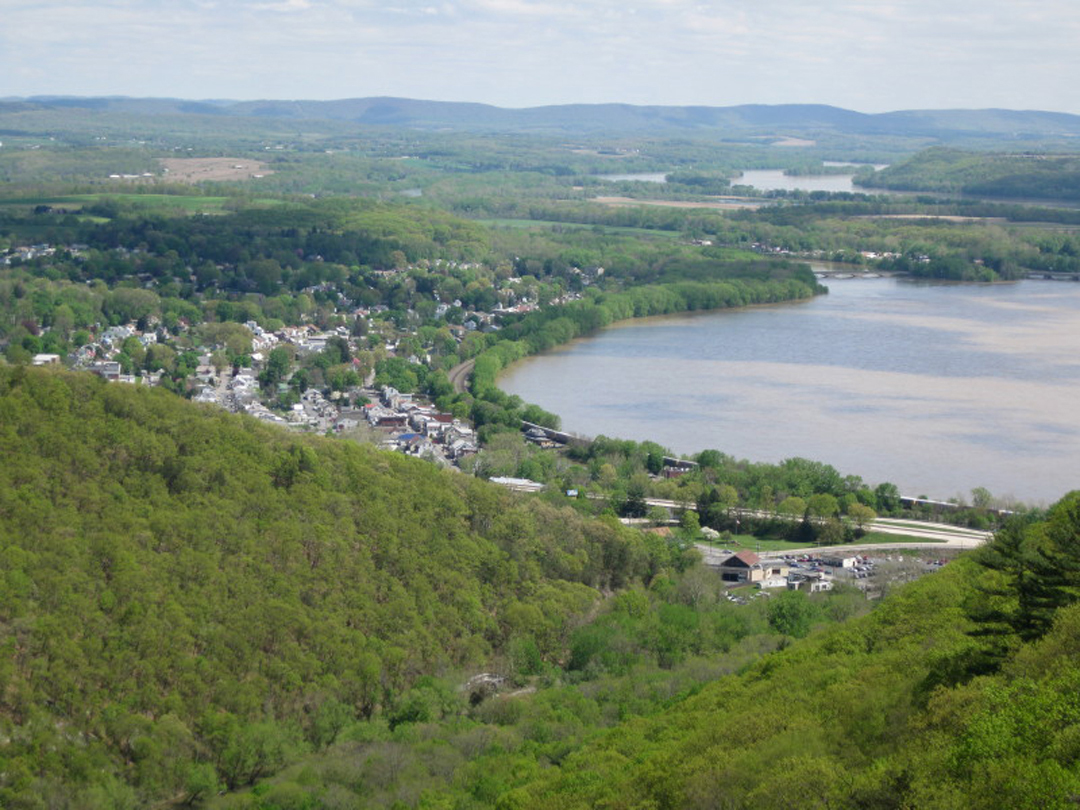
Town of Duncannon
Psalms 3:4
To the Lord I cry aloud, and he answers me from his holy hill.
Monday, May 2, 2011
Food Carried on a Five Day Hike by Weight
Many hikers carry 50 pounds and up in their packs and have no problem doing it. This post is for those who need to carry less weight in their packs. Most hiking books state that hikers carry on an average of 2 pounds of food per day. Two pounds is equal to 907.18 grams.
Lets First Look at Tuesday the first day of the hike.
Breakfast is not included because the hike started after the meal.

Chili Mac Dinner 82g
Cliff Bar Lunch 48g
Cliff Shot Extra Energy 34g
Mars Bar After Dinner Snack 54g
Crystal Light Dinner Drink 04g
Mixed Nuts Lunch 44g
Nutrient Drink Evening drink 32g
Plastic Bag 08g
Total 306g
Second Day Wednesday Full Day

Chili Mac Dinner 84g
Oatmeal Packet Breakfast 36g
4 Packs Raw Sugar for Coffee 20g
Honey 2 Packs for Oatmeal 22g
Creamer 04g
Coffee Bag 06g
Breakfast Cookie 50g
Mixed Nuts Lunch 48g
Crystal Light 04g
Cliff Shot 34g
Cup of Soup Packet 16g
Power Bar Lunch 68g
Mars Bar 52g
Nutrient Powder 36g
Bag 10g
Total 490g
Thursday Hike

Mac and Cheese 104g
Pop Tarts Bag 106g
Mars Bar 52g
Power Bar 70g
Creamer 02g
Mixed Nuts 44g
4 Packs Raw Sugar 20g
Cliff Shot 32g
Soup Packet 16g
Breakfast Cookie 48g
Nutrient Powder 32g
Tea Bag 02g
White Sugar packet 06g
Crystal Light 04g
Coffee Bag 04g
Plastic Bag 10g
Total 552g
Friday Hike

Beef Trekkie 94g
Mars Bar 50g
Cliff Shot 32g
Oatmeal 46g
Big 100 Bar 104g
Coffee Bag 04g
4 Pack Raw Sugar 20g
Crystal Light 04g
Creamer 04g
White Sugar 2 Pack 06g
4 Packs Honey 38g
Mixed Nuts Packet 46g
Tea Bag 02g
Nutrient Drink 30g
Plastic Bag 10g
Total 490g
Saturday Hike Evening Meal is Not Included

Pop Tarts 110g
Cliff Bar 70g
Mars Bar 50g
Mixed Nuts 46g
Coffee Bag 04g
Nutrient Powder 32g
Crystal Light 04g
Creamer 04g
4 Pack Raw Sugar 16g
Cliff Shot 32g
Bag 10g
Total 378
The grand total of food I carried for all five days was 2,216 grams converted to 4.89 pounds. This is just about one pound per day.
So if you want to pack ultralight you do not have to pack on an average of 2 pounds of food per day. Of course this does not include water nor the food bag to carry the food.
Thursday, February 24, 2011
Winter Hike
The Trails are Calling
I have been like the black bears in the Blue Ridge Mountains of Virginia in hibernation coming out for the first time this year. I took my first hike of the year in February of this year. It was along one of my favorite hikes a 8 mile plus hike of Doyles' and Joneses Run. I love the views of the small waterfalls along both streams. I also wanted to try out an ultralight pack I ordered from Ultralight Backpacking. I am always in the hunt for light weight backpacking equipment. I was diagnosed with a loss of all of my cartilage in my knees about 15 years ago after many years of marathon and ultramarathon running. The doctors said I needed two knee replacements and I would not run or hike again. After three doctors opinions I decided to take glucosamine and chrondroitin and forget the doctors advise. I may not be the fastest hiker but I am still hiking the trails. I grew up in the country and I feel like I must return to it to be complete. The Doyles' and Joneses Run hike was perfect to start my season.
Waterfalls
Therapy
In Virginia we look for the black bear to come out of hibernation in the month of February. I love to hike the trails looking for the signs of bear activity. I usually find bear tracks and scat along the trail.

While taking pictures of the waterfalls along the trail I was almost hit by falling sheets of ice.
When I hike in the mountains I am reminded of the scripture Isaiah 49:13 - Sing, O heavens; and be joyful, O earth; and break forth into singing, O mountains: for the Lord hath comforted his people, and will have mercy upon his afflicted.
Wednesday, December 15, 2010
AT Hiking
The Long Green Tunnel
It is all so true what some might say about hiking the Appalachian Trail in wooded areas for long periods of time, these hikers say that they get bored while traveling long distances looking at that same scenery. I look at it as another piece of God's creation. There are so many people who will never see those long spans of cool shaded trails. There are others that cannot physically walk the trail and would give anything to see that same scenery that some might see as boring.
I look beyond the obvious for the hidden surprises like animals, plants and rocks that tell the story of the AT. The following videos tell a story of what I found along one of my recent AT hikes in Virginia and Tennessee.
Saturday, October 30, 2010
Pentatoma rufipes- Mountain Stink Bug
One of the most pesty pests on the Appalachian Trail is the stink bug. September and October are the worst months for the hiker. The bugs are everywhere. They seem to like to stay in the shelters in very large numbers in the hundreds. In camp they like to try to attach to you everywhere. I was eating and one tried to fly into my mouth. The SB prefers to host on all wild plants. The SB likes to feast on plant seeds. They overwinter as adults and become active in the spring. The female lays several hundred eggs on leaves and stems. It takes five weeks to go from egg to adult. Birds are the SBs natural enemy. They emit an unpleasant odor which repels most enemies. I recently hiked from Caledonia State Park in Pennsylvania to Harper's Ferry and encountered hundreds of SB's along the trail. When I returned home I discovered SB's attached to my tent and auto. In the past people have used animals or parts of animals as money. The scalps of woodpeckers and the tails of giraffes have been used. Since we have so many stink bugs in the east why not use then for money. They are plentiful in Pennsylvania but absent in other places. They could be referred as to as "bug money." I think we shall have dominion over the insects.
Genesis 1:26 .......... and let them have dominion over .............every creeping thing that creepeth upon the earth.
Sunday, September 26, 2010
The sodium connection

1. It regulates the amount of water in our body governing the passage of fluids in and out of the cells and helping the cell membranes remain elastic.
2. Salt is needed in the digestive system for metabolism of carbohydrates and proteins and by the nervous system to aid in the transmission of nerve impulses.
3. Sodium also interferes with regulating the electrolytes into cells.
4. It helps maintain the electrolyte balance of the body also helps in muscle contraction.
Table salt is composed of 40% sodium and 60% chloride. If you eat 10 grams of table salt 4 grams(g) are sodium. A large amount of sodium leads to high blood pressure. One gram of sodium is less than a teaspoon and more than meets the daily requirement. The average American eats 8 to 12 grams a day. Often the excessive salt is passed out of the body by the kidneys but in 30 to 50 % of the people the kidneys can't keep up. If the sodium builds up in the blood water will also build up restricting blood flow and high blood pressure results. As we grow older our kidneys become even less efficient.
Many manufacturers of foods add salt as a preservative to add shelf life. Many doctors believe that 77 % of the salt in our bodies comes from commercial additives (ca).
Some examples of ca are:
1. Food additives -
a. Soft drinks - sodium cyclamate
b. Preserved fruits - sodium sulfite
c. Desserts - Sodium citrate
d. Antimold in cheese - Sodium propionate
e. Meats - Sodium nitrate
f. Sweetener - sodium saccharin
g. Ice cream - sodium caseinate
h. Skin softener - sodium hydroxide
i. Condiments, dressings - sodium benzoate
2. MSG - monosodium glutamate - flavoring and tenderizer
3. Dry skim milk - heavy in salt
4. Baking powder - kitchen favorite
5. Brine - pickles, olives, feta cheese, corned beef
So the secret is to avoid the salt in prepared foods.
Lets look at a few samples:

Clif Bars

The average clif bar contains 130 mg (milligrams) of sodium and 310 mg of potassium. Potassium can act as a substitute for salt but does not increase the amount of water in the blood. A good ratio of sodium to potassium is 1 to 3.

Organic Trek Mix
Sodium is 0 mg.

Most prepackaged backpacking foods are very high in sodium. Many hikers eat the whole pack but you must remember it contains 2 helping and twice the listed sodium per helping. Try to prepackage the pouch into 2 separate bags and only eat the meals that are around 800 to 900 mg.

Ramen noodles
Ramen noodles are very high in sodium if you add the flavor cube provided in the package. Instead add a low sodium bullion cube.
I have tried to give you some information on sodium, extend your hiking years by staying away from sodium.
Subscribe to:
Posts (Atom)